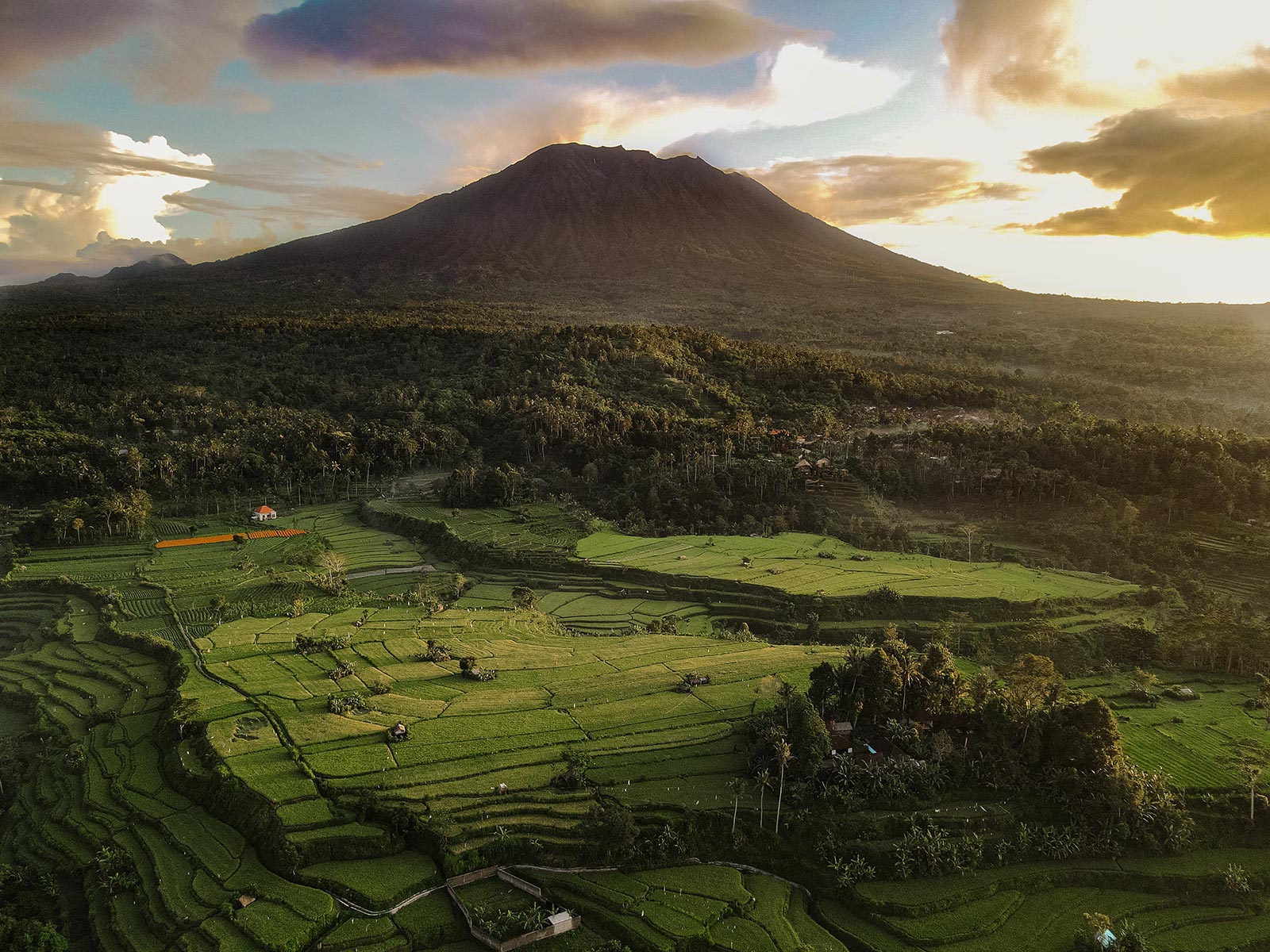
Global brands choose Bali because it compresses remarkable visual diversity — rice terraces, volcanic terrain, tropical forest, black sand coastlines, and luxury resort architecture — into a compact, navigable geography. Combined with a mature local production infrastructure, costs that deliver more creative ambition per dollar than Europe or Australia, and a strategic position at the centre of Southeast Asia's four-billion-person consumer market, Bali delivers value no comparable regional destination can match.
For a growing list of global brands, the answer is Bali.
This isn't a trend driven by cost alone, though the economics are compelling. It's driven by what Bali actually delivers: a visual landscape that is genuinely unique, a production infrastructure that has matured into world-class capability, and a creative culture that has been quietly attracting serious international talent for years. Tourism boards, aviation brands, luxury hospitality groups, and global activewear companies are all producing here. The question worth asking is why.
A Landscape That Cannot Be Replicated
The most obvious reason is the visual environment, and it's worth being specific about what that means in practice.
Within a single island, Bali offers ancient rice terrace systems with centuries of agricultural architecture, dense equatorial rainforest with old-growth canopy, volcanic highland terrain above the cloud line, black and white sand coastlines, dramatic sea cliffs, and one of the highest concentrations of luxury resort architecture in the world. These are not interchangeable backdrops. Each zone carries a distinct visual identity, and a production that understands how to move between them can generate content that looks like it was shot across five different countries.
That compression of visual diversity into a compact, navigable geography is genuinely rare. Comparable locations, parts of New Zealand, certain regions of Singapore, Thailand, Vietnam or Sri Lanka, exist, but none combine Bali's visual range with its existing production infrastructure and logistical accessibility.
For brands building a content ecosystem across multiple campaigns, formats, and seasonal moments, that diversity is not a luxury, it's an efficiency multiplier.
The Economics Are Real - But Not How You Think
Production in Bali costs less than equivalent productions in Europe, Australia, or North America. That is true. But framing this purely as a cost story misses the more interesting argument.
The relevant comparison is not "how much cheaper is Bali than London?" It's "how much more do we get in Bali for the same budget?"
A mid-level commercial production budget in Bali: crew, locations, equipment, accommodation, logistics, post-production - stretches significantly further than the same number spent in a Western production centre. That difference does not translate into a lower-quality result. It translates into a more ambitious one: more shoot days, more locations, larger crew, more comprehensive post, more campaign assets delivered within the same financial envelope.
Brands that understand this shift from cost-saving to value-expansion are the ones using Bali most effectively. They're not cutting corners, they're capturing more.
Infrastructure That Has Grown Up
A decade ago, producing in Bali required importing significant crew and equipment from Australia or Singapore. That is no longer the case.
Bali now has a resident pool of cinematographers, directors, producers, and editors who have trained internationally and chosen to base themselves here. The equipment infrastructure - professional cinema cameras, stabilisation systems, licensed aerial operators, grip and lighting exists locally at the standard international productions require. Post-production facilities capable of handling colour grading, sound design, and platform-specific delivery to international broadcast standards are embedded in the island's production ecosystem.
This maturation matters for practical reasons. It reduces the cost and complexity of importing crew. It means local knowledge - of light, of locations, of logistics, of permit processes - is carried by the people actually operating the cameras. And it means productions that engage with established local partners inherit years of relationship-building with location owners, government authorities, and community liaisons that would take an incoming brand years to develop independently.
Access to a Market of Four Billion People
Geography is a strategic asset as much as a visual one.
Bali sits at the centre of Southeast and East Asia, a region home to more than four billion people, with a growing middle class, rising appetite for premium brands, and cultural diversity that is itself a creative resource. For brands whose growth story runs through this part of the world, producing content in Bali is not just practical. It's a positioning statement.
The proximity also has logistical advantages. Production teams from Australia, Singapore, Japan, South Korea, and across Southeast Asia can reach Bali in a matter of hours. International flights connect directly from major European and American hubs. And the time zone - GMT+8 - means real-time collaboration with clients across Asia and reasonable overlap with European working hours.
Regional brands including tourism boards, aviation companies, and hospitality groups have recognised this for years. Brands entering Asian markets are discovering it now.
How Bali Compares to Other Regional Production Destinations
The honest comparison matters for brands evaluating their options.
Thailand (primarily Bangkok and Phuket) offers strong infrastructure and established production industry, but visual familiarity is a genuine concern - the locations have been used extensively by international productions for decades.
Singapore is a world-class production hub with exceptional infrastructure and regulatory clarity, but its visual palette - urban, contemporary, constrained geography - limits the range of content it can credibly produce. It is an excellent base of operations; less compelling as a primary shoot location.
Sri Lanka offers extraordinary visual diversity and lower costs than Bali, but infrastructure is less developed and logistical complexity is higher, particularly for larger productions.
Vietnam (Da Nang, Hoi An, Ho Chi Minh City) is increasingly competitive, with beautiful locations and growing crew infrastructure, but further from the maturity of Bali's established production ecosystem.
Bali's position in this comparison is the combination: visual range, infrastructure depth, logistical accessibility, and a creative culture that has been building for long enough to be genuinely reliable at the scale global brands require
What the Best Productions Have in Common
Across the range of international brands that produce in Bali, from global activewear companies running long-term content partnerships, to tourism boards producing flagship campaign films, to aviation brands building brand stories across the region, the productions that perform best share a few characteristics.
They engage a local production partner early, before creative decisions are locked, so that location knowledge and production logistics can shape the creative rather than fight against it. They plan for the full permit process, National Film Permits, C14 Film Visas for international crew, location-specific approvals, rather than discovering these requirements late. They design their production as a content system, not a single deliverable, so the investment in logistics and location generates multiple asset streams. And they build relationships that compound: the second production with the same partner is always more efficient and more creatively ambitious than the first.
What the Best Productions Have in Common
WeDo Creative is a Bali-born production collective that has been delivering cinematic campaigns for global brands since 2018. Our directors and DOPs are embedded across Bali and the wider region, with the production infrastructure to deliver at scale, from single-day brand content shoots to long-term global campaign partnerships.
Our work spans global activewear campaigns, international tourism board films, luxury hospitality content, fashion campaigns, and brand stories for clients across Asia, Australia, and Europe.
If you're evaluating Bali as a production destination and want an honest conversation about what's achievable, reach out. We'll tell you exactly what your budget can do here.
Frequently Asked Questions
Why do global brands choose Bali for commercial production?
Global brands choose Bali for three compounding reasons: rare visual diversity (rice terraces, volcanic highlands, tropical forest, dramatic coastlines, and luxury resort architecture within a 45-minute drive), a mature local production infrastructure with world-class crew and equipment, and production costs that deliver significantly more creative ambition per dollar than equivalent shoots in Europe, Australia, or North America. The geography also provides strategic access to Southeast Asia's four-billion-person consumer market.
How does Bali compare to Thailand for commercial film production?
Thailand offers strong production infrastructure, but visual familiarity is a genuine concern — its locations have been used extensively by international productions for decades. Bali offers greater visual distinctiveness alongside comparable infrastructure depth. For brands producing content that must feel genuinely unique rather than recognisably South Asian, Bali is the stronger production destination.
How does Bali compare to Singapore for commercial production?
Singapore is a world-class production hub with exceptional infrastructure and regulatory clarity, but its constrained urban geography limits the range of visual content it can produce. Bali is the stronger choice for brands requiring cinematic landscapes and environmental variety. Singapore functions well as a regional base of operations or for contemporary urban content specifically — the two destinations serve different creative briefs.
Is Bali affordable for commercial film production?
Bali is cost-competitive compared to Western production centres, but the better framing is value expansion rather than cost reduction. The same budget spent in Bali delivers more: more shoot days, more locations, larger crew, more comprehensive post-production. Brands producing in Bali are not cutting corners — they are capturing more campaign assets and greater creative ambition within the same financial envelope.
What time zone does Bali operate in for international production?
Bali operates on GMT+8 (WITA — Central Indonesia Time). This enables real-time collaboration during business hours with clients across Australia, Japan, South Korea, and Southeast Asia, and provides a workable overlap with European time zones. For international brand teams managing productions remotely, Bali's time zone is one of the most logistically practical in the region.
What visual environments can you film in Bali?
Within a single compact island, Bali offers ancient rice terrace systems with centuries of agricultural architecture, dense equatorial rainforest with old-growth canopy, volcanic highland terrain above the cloud line, black and white sand coastlines, dramatic sea cliffs, and one of the highest concentrations of luxury resort architecture in the world. Each zone carries a distinct visual identity, enabling a single production to generate content that appears shot across multiple countries.

Stay Close to the Collective.
New films, production stories, and behind-the-scenes dispatches, follow us on Instagram and LinkedIn, or reach us directly on WhatsApp.