Planning a commercial production in Bali requires a minimum of 6–8 weeks lead time for a standard campaign and 12 weeks for larger international productions. Every foreign production needs a National Film Permit, C14 Film Visas for international crew, and location-specific permits. Budget ranges from $8,000–$30,000 USD for entry-level content to $100,000+ for large-scale campaigns with licensed aerial and full post-production.
But producing in Bali is not the same as producing anywhere else. The island rewards brands that plan carefully and punishes those that don't. This guide covers everything you need to know before your first scout email lands in an inbox, timeline, locations, crew, permits, budget, and timing.
Why Global Brands Choose Bali
The straightforward answer is variety. Within a 45-minute drive from Ubud, you can move from ancient rice terraces to black sand coastlines to dense tropical rainforest to contemporary luxury resort architecture. For a production team, that means multiple looks and multiple campaign assets captured within a single shoot window, dramatically improving cost efficiency without compromising visual quality.
Beyond geography, Bali has built a genuine production ecosystem: experienced local crew, established logistics networks, world-class post-production facilities, and a deep pool of international creative talent that has chosen to base itself here. Brands ranging from global activewear companies to international tourism boards and luxury hospitality groups have been producing here for years, and that history shows in the quality of what the island can deliver.
How Far in Advance Should You Plan?
For a standard commercial campaign, two to five shoot days, a crew of 10 to 20, multiple locations, the minimum realistic lead time is six to eight weeks. For larger productions involving international talent, licensed aerial, multi-location logistics, and campaign assets requiring Clearcast or equivalent regulatory approval, plan for 12 weeks minimum.
The key milestones to work backwards from:
Post-production delivery date (your fixed endpoint)
Final shoot day (allow at least four weeks of post from this point for colour, sound, and revisions)
Production start (first shoot day, everything below feeds into this)
Location lock (2–3 weeks before production starts)
Permits submitted (at least 3–4 weeks before shoot, often longer for government or protected sites)
Crew confirmed and briefed (3 weeks before production)
Creative and shot list approved (before any of the above moves forward)
The single biggest mistake brands make is compressing pre-production. A compressed pre-production on a Bali shoot will cost you in location fees, overtime, and compromised creative decisions made under pressure.
What Bali Actually Offers
Understanding Bali's geography before you scout makes your decisions faster and your budget more predictable. The island's main production zones each carry a distinct visual identity:
Ubud and the Central Highlands
Lush, verdant, cinematic. Rice terraces, jungle canopy, rivers, traditional architecture. This is Bali's most iconic visual palette and the location that most international campaigns reach for first. Requires transport from coastal areas.
Seminyak and Canggu
Contemporary, editorial, coastal. Modern villas, beach clubs, lifestyle locations. Suits fashion, hospitality, and lifestyle brands. Permit requirements are lighter here than in protected cultural zones.
Uluwatu and the Bukit Peninsula
Clifftop drama, ocean views, minimal visual noise. Extraordinary for luxury and aspirational content. Limited crew access to some sites; plan logistics carefully.
East Bali (Amed, Tirta Gangga)
Less trafficked, deeply traditional, extraordinary for authentic local colour. Under-used by commercial productions and, as a result, visually distinctive.
North Bali (Lovina, Munduk)
Remote, mist-covered highlands and unspoiled coastline. A strong choice for brands wanting Bali's beauty without the visual signatures that feel overexposed.
The practical advice: don't lock locations from photographs alone. Scout in person, or work with a production partner whose scouts are embedded in each zone.
Permits and Legal Requirements
This is where productions without a trusted local partner most often run into trouble. Permits in Indonesia operate across multiple layers: location, crew, and national and missing any one of them can halt a production or create serious legal exposure.
Location permits
Vary by site type: private property requires owner agreement; cultural or sacred sites require government and community approval, often including a mandatory ceremony and dedicated community liaison; national parks and protected areas go through a separate government permit process; and public spaces need local government or banjar permission. Each category has its own timeline and its own set of relationships to navigate.
Licensed aerial footage
Any drone work requires additional permits through DGCA Indonesia and must be operated by a licensed operator. This is non-negotiable. Penalties for unlicensed aerial filming are significant, and footage shot without proper clearance creates legal risk for the brand as well as the production company.
National Film Permit
Any commercial production shooting in Indonesia requires a National Film Permit issued through the Indonesian government. This is a mandatory requirement for all foreign productions and many domestic commercial shoots. The permit process involves submitting production details, shoot locations, and intended distribution to the relevant authority. Budget at least three to four weeks for this process, and more if your production involves sensitive locations or government-affiliated subjects.
C14 Film Visas for international crew
Any foreign crew member working on a commercial production in Indonesia must enter on a C14 Film Visa, not a standard tourist or business visa. Arriving on the wrong visa and working is illegal, and the consequences: crew deportation, production shutdown, are severe enough to end a shoot entirely. The C14 process requires a local Indonesian sponsor (typically your production company), a formal invitation letter, and documentation of the production. Processing time varies but should be factored in from the moment the international crew is confirmed.
The practical approach: build a permit and visa matrix at the start of pre-production. List every crew member's nationality, every location type, and every permit category, then work backwards from your shoot date. A production partner with established relationships across Indonesian government bodies, the film authority, and DGCA will move this process significantly faster than an incoming brand trying to navigate it cold.
Building Your Crew
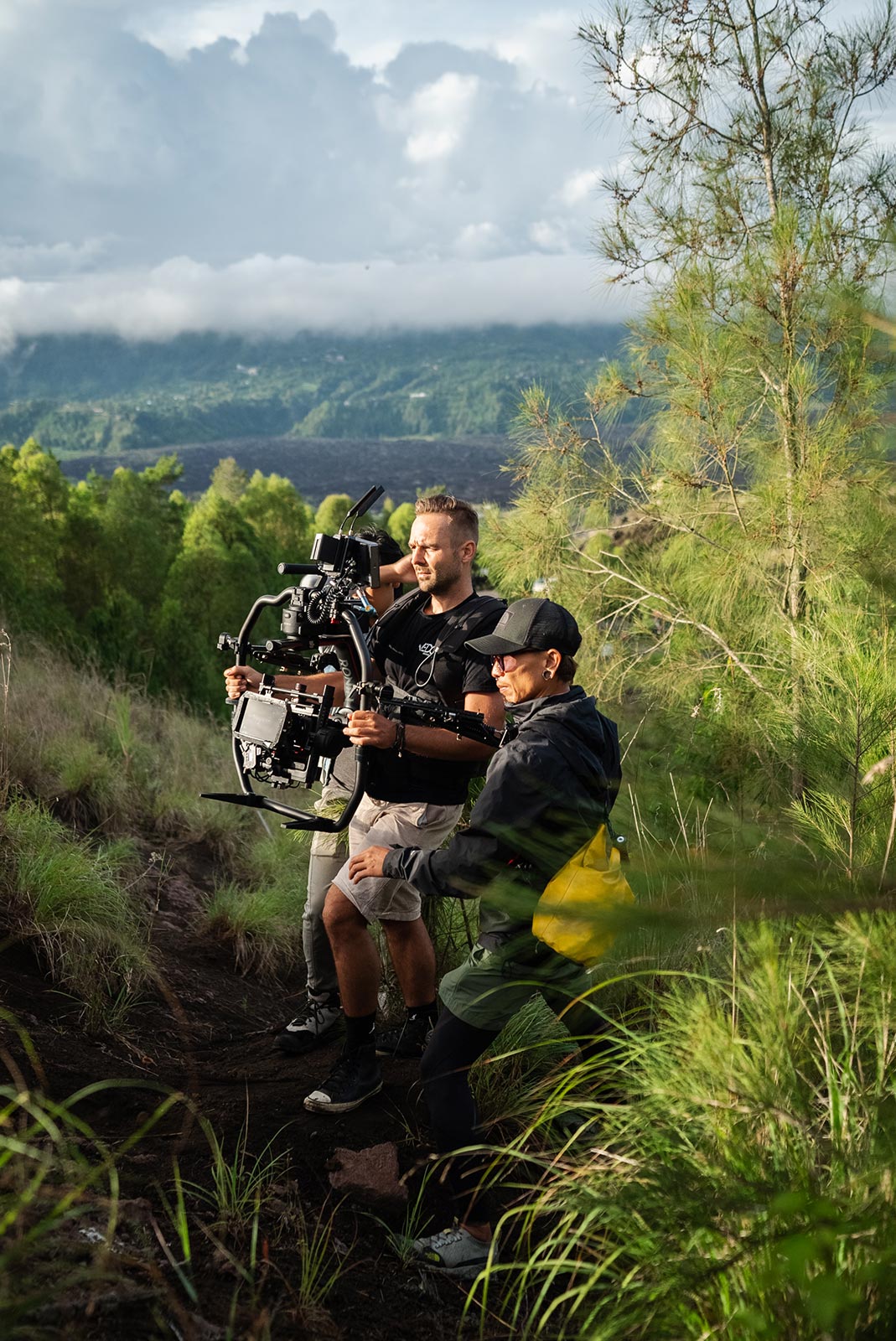
The best Bali productions run on a hybrid crew model: a creative core including director, DOP, producer, who bring the vision and client relationship, combined with a strong local production infrastructure that knows how to execute in the specific conditions of the island.
What to look for in a Bali production partner:
A proven portfolio in your category: hospitality work and activewear campaigns, for example, require meaningfully different visual approaches and crew configurations
Established location relationships: access and negotiating leverage built over time
In-house or closely integrated post: seamless handoff from set to grade to delivery
A scalable asset system: the ability to capture photography, long-form video, and short-form social content within a single production window, maximising your investment
A production collective model: a curated group of directors, DOPs, editors, and producers working together under one roof, tends to outperform traditional agency-subcontracted models in Bali, particularly for brands that need both creative ambition and operational reliability.
What to Budget
Bali offers genuine production value per dollar compared to equivalent shoots in Europe, Australia, or North America. but "affordable" is relative, and under-budgeting a Bali production creates the same problems as under-budgeting anywhere else.
Rough budget ranges for reference:
Entry-level brand content (1–2 shoot days, small crew, single location): $8,000-$30,000 USD
Mid-level commercial campaign (3–5 shoot days, full crew, multiple locations, photography + video): $30,000–$70,000 USD
Large-scale international campaign (multi-week, licensed aerial, international talent, full post): $100,000 USD+
These ranges vary significantly based on talent fees, location costs, post-production scope, and whether you're building a one-time asset or a scalable content system for ongoing use. The most cost-efficient approach for brands producing regularly in Bali is a long-term production partnership, where infrastructure, relationships, and creative familiarity compound over time.
Timing and Weather
Bali's dry season runs roughly from April through October. This is peak production season for good reason. Light is consistent, outdoor shoots are predictable, and logistics are smoother. If you have the flexibility to choose your dates, shoot between May and September.
The wet season (November through March) is not a production impossibility. Bali's west coast tends to get more rain than the east, mornings are often clear, and some productions specifically seek the atmospheric quality of overcast tropical light. But plan for weather contingency days in your schedule and budget if you're shooting in wet season.
The one timing factor that overrides weather: Nyepi, Bali's Day of Silence, falls in March each year. The island shuts down entirely for 24 hours. Plan around it.
What a Scalable Production System Looks Like
The most forward-thinking brands in the world aren't approaching Bali as a one-off location. They're building ongoing production partnerships that function more like a content engine than a single campaign.
The structure looks different for every brand. Some clients produce one concentrated multi-day window per year: a five-day shoot that generates a full year's worth of photography, brand film, social content, and paid media assets in a single efficient cycle. Others run lighter, more frequent shoots tied to product launches or seasonal campaigns: a one or two-day production every quarter, each feeding a specific moment in the marketing calendar. Both models work. The difference is intentionality.
What they share is the same underlying logic: assets are planned as a system, not a one-time output. Creative direction, locations, and crew build familiarity across each production cycle. What the brand needs in month nine is already being considered in month one.
This is how a long-term creative partnership compounds value: each production cycle inherits the creative learning, location relationships, and production efficiency of the one before it. Costs per asset drop. Creative ambition rises. And the brand stops treating production as a cost centre and starts treating it as a growth lever.
Ready to Produce in Bali?
We Do Creative is a Bali-born production collective delivering cinematic campaigns for global brands. With a curated team of directors and DOPs embedded across Bali, Asia, Australia, and Europe, we've built a production infrastructure designed to deliver at scale, from single-day brand content to multi-campaign global partnerships.
If you're planning a production in Bali and want to understand what's possible, start a conversation with us. We'll help you scope it, plan it, and build something that works beyond the shoot.
Frequently Asked Questions
How much does a commercial production in Bali cost?
Commercial production in Bali costs $8,000–$30,000 USD for entry-level brand content (1–2 shoot days, small crew, single location), $30,000–$70,000 for mid-level campaigns (3–5 shoot days, full crew, multiple locations, photography and video), and $100,000+ for large-scale international productions with licensed aerial, international talent, and comprehensive post-production. These ranges vary based on talent fees, location costs, and post scope.
How far in advance should you plan a commercial production in Bali?
Plan a minimum of 6–8 weeks ahead for a standard commercial campaign of 2–5 shoot days with a crew of 10–20 people. For larger productions involving international talent, licensed aerial footage, and regulatory approvals, allow at least 12 weeks. The single biggest mistake brands make when producing in Bali is compressing pre-production time, which increases location fees, overtime, and creative compromise.
Do you need permits to film commercially in Bali?
Yes. All commercial productions shooting in Indonesia require a National Film Permit from the Indonesian government. Additionally, every location type requires its own permit: private property needs owner agreement, cultural or sacred sites require government and community approval, national parks have a separate government process, and drone work requires DGCA Indonesia clearance with a licensed operator. Budget 3–4 weeks minimum for the permit process.
What visa do international film crew need to work in Bali?
International crew working on commercial productions in Indonesia must enter on a C14 Film Visa — not a tourist or business visa. The C14 requires a local Indonesian production company as sponsor, a formal invitation letter, and production documentation. Arriving on the wrong visa and working is illegal; consequences include crew deportation and full production shutdown. Factor C14 processing time in from the moment international crew are confirmed.
When is the best time of year to shoot a commercial production in Bali?
Bali's dry season runs April through October, with May through September the most reliable window. Light is consistent, outdoor logistics are predictable, and weather contingency is rarely needed. The wet season (November–March) is possible with contingency days built in. One hard constraint: avoid Nyepi — Bali's Day of Silence, falling in March — when the island shuts down entirely for 24 hours and no production is possible.
What filming locations are available for commercial productions in Bali?
Bali offers five distinct production zones within a compact geography: Ubud and the Central Highlands (rice terraces, jungle, traditional architecture), Seminyak and Canggu (contemporary coastal lifestyle), Uluwatu and the Bukit Peninsula (clifftop ocean drama), East Bali including Amed and Tirta Gangga (traditional, under-used, visually distinctive), and North Bali including Lovina and Munduk (remote highland terrain and unspoiled coastline). Multiple looks are achievable within a single production window.

Stay Close to the Collective.
New films, production stories, and behind-the-scenes dispatches, follow us on Instagram and LinkedIn, or reach us directly on WhatsApp.